A tracker’s biggest risk isn’t getting lost—it’s dying. The right coin cell is the key to true protection.
A tracker’s biggest risk isn’t getting lost—it’s dying. The right coin cell is the key to true protection.
The regrets that can never be undone are often foreshadowed the moment a battery nears depletion.
At an airport baggage carousel, a tracking app shows a location from forty minutes ago—not due to signal interference or device failure, but simply because the coin-cell battery inside the tracker has run out of power. On a residential community notice board, a "missing person" flyer appears; the anti-lost device on an elderly person’s wrist went offline in the early hours of the morning, its low-battery alert silenced—by the time family members realized, the device had already been offline for some time. A cat wanders off from a balcony, yet the final location reported by its tracker is a garage where it had only lingered for a brief moment three days prior.
Across these three scenarios, the core issue remains the same: the hardware is functional, the platform is stable, and the chip performance is sufficient—yet the battery fails to hold up when it matters most.
This highlights the unique power requirements of Bluetooth/UWB anti-lost tags: they spend the vast majority of their time in a dormant state, emitting only low-power, periodic signals. However, the critical actions that determine success—waking up, ranging, and sounding an alarm—invariably occur during the most urgent moments, when failure is not an option. Therefore, the reliability of an anti-lost device depends not only on its positioning accuracy but also on the battery’s ability to maintain a stable voltage during the precise instant of radio-frequency (RF) transmission, ensuring the data is successfully sent.
With over two decades of expertise in micro-lithium power solutions, Power Glory offers the CR-PH high-capacity series (including models such as the CR2032PH, CR2025PH, and CR2450PH). These batteries are engineered for devices that must remain silent and on standby for long periods, yet respond reliably at critical moments. They feature superior pulse-discharge capabilities, higher capacity within the same physical dimensions, an annual self-discharge rate of less than 2%, and stable output across a wide temperature range (-20°C to +70°C).
Note: This article focuses on coin-cell-powered products, such as Bluetooth/UWB anti-lost tags, key-fob trackers, and small location tags. Heavy-duty tracking terminals—which often feature screens and 4G connectivity—typically utilize built-in rechargeable batteries and are therefore outside the scope of this discussion.
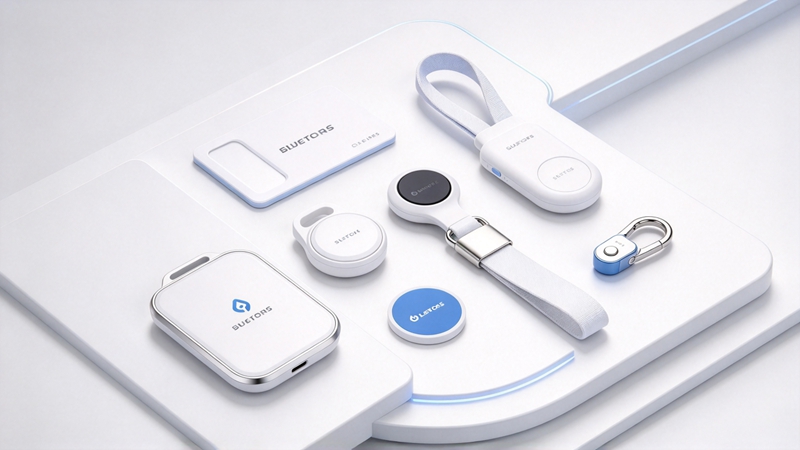
The true test of an anti-lost tracker isn't its app—it’s the voltage delivered at the moment of transmission.
When choosing an anti-lost tracker, many people obsess over location accuracy, UWB capabilities, or app usability, while overlooking the humble coin-cell battery inside.
Yet, this is precisely where most tracker failures originate. Every time the device broadcasts a Bluetooth signal, responds to a search request, or initiates UWB ranging, the radio-frequency (RF) chip demands a sudden, high-current surge—lasting only milliseconds. Standard coin-cell batteries often struggle with these abrupt loads, causing a sharp drop in voltage. In the best-case scenario, this leads to packet loss, sluggish response times, or a reduced effective search range; in the worst case, the device’s internal circuitry detects a low-voltage state and enters a sleep mode. When you see that glaring "Device Offline" alert on your phone, it’s often not because the signal has been lost, but because the battery failed to deliver the necessary power the moment it was called upon to wake up.
In the industry, a typical CR2032 battery offers a nominal capacity of 200–240 mAh and a pulse discharge capability of around 15 mA. In contrast, the Power Glory CR2032PH boasts a capacity of 245 mAh and a pulse discharge capability of up to 18 mA. A higher capacity generally translates to longer battery life, while that extra margin in pulse current determines whether your tracker—tucked away deep in a sofa crevice or buried in a suitcase—will successfully sound an alarm when you tap "Play Sound" in the app.
High pulse capability does not mean the battery is designed for continuous high-current discharge; rather, its value lies in its ability to withstand millisecond-long bursts of demand, keeping the output voltage stable and preventing the sudden voltage drops that would otherwise cause a search attempt to fail.

For the "Power Glory CR-PH" series, understanding the "PH" suffix is the key to choosing the right battery.
Once you have the correct dimensions, the next step is to evaluate performance.
Knowing the dimensions is just the basics; what truly determines performance are the two letters in the model suffix:
P = High Pulse: Anti-loss trackers are pulse-type loads—they remain in a low-power, microampere-level standby state for long periods, drawing a sudden surge of current only when a search is initiated. The "PH" version maintains a stable voltage during these radio-frequency bursts, preventing signal loss or sluggish response times caused by voltage drops, ensuring the device reacts instantly to search commands.
H = High Capacity: For a given size, this version offers 10%–20% more capacity than standard models. This extends the time between replacements, sparing you the hassle of frequent battery changes or the risk of installing the wrong type.
There is also a frequently overlooked specification: ultra-low self-discharge. Anti-loss trackers are often left idle for long periods or remain attached to items for months without being checked. Thanks to a proprietary encapsulation process, the Power Glory CR-PH series features an annual self-discharge rate of less than 2%. This ensures that even after long-term storage, the battery retains ample power when installed in a device—unlike products with higher self-discharge rates, which might lose their charge before you even get a chance to use them.

A Full Range of Models: From Slim Anti-Loss Tags to Pet ID Tags
CR Naming Convention: The first two digits represent the diameter (in mm), and the last two digits represent the thickness multiplied by 10 (in mm). For example, a CR2032 battery has a diameter of 20 mm and a thickness of 3.2 mm. Even if batteries share the same 3V voltage, they are not necessarily interchangeable: a mismatch in diameter means the battery cannot be installed; a battery that is too thin may become loose and result in poor contact; and a battery that is too thick may compress the battery compartment or damage the circuit board. Always refer to the markings on the device’s battery compartment or the user manual to determine the correct model.
Model | Diameter × Thickness | Nominal Capacity | Typical Application Scenarios |
CR2032PH | 20 × 3.2 mm | 245 mAh | Card-type anti-loss tags, keychain trackers; one of the mainstream flagship specifications for standard tags |
CR2025PH | 20 × 2.5 mm | 165 mAh | Ultra-thin card-type anti-loss tags, lightweight pendants |
CR2450PH | 24.5 × 5.0 mm | 620 mAh | Long-battery-life tags with buzzers, high-capacity locating fobs |
CR2430PH | 24.5 × 3.0 mm | 300 mAh | Large-diameter thin devices, select pet collar trackers |
CR1632PH | 16 × 3.2 mm | 140 mAh | Compact anti-loss fobs, thin and lightweight wearable trackers |
CR1620PH | 16 × 2.0 mm | 80 mAh | Micro anti-loss patches, mini tags |
The entire series features high-pulse and high-capacity characteristics, with an annual self-discharge rate of less than 2% and an operating temperature range of -20°C to +70°C. As device designs vary significantly, please prioritize using the specific model number recommended by the original manufacturer.
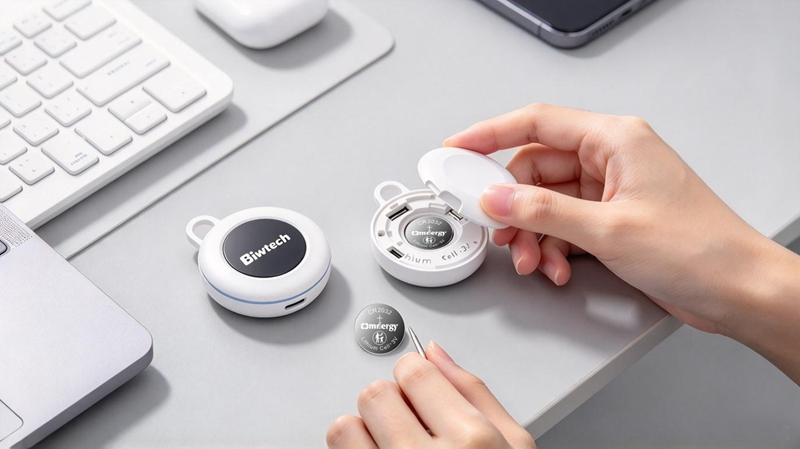
A Three-Step Guide to Replacing Batteries—Don’t Skip a Single Step
Step 1 · Check the markings; don’t rely on memory. Open the battery compartment and read the full model number of the old battery, including any suffixes like "PH." If the original is a CR2032PH, do not replace it with a standard CR2032. While they may share the same dimensions, their performance characteristics differ; a standard battery might connect via Bluetooth, but it could suffer a voltage drop and fail exactly when you need it most.
Step 2 · Verify dimensions; never force a fit. Never swap batteries if the diameters differ, and do not jam a battery in if the thickness isn't right. After installation, immediately trigger the "play sound" function—this is the simplest and most effective way to verify that the power supply is reliable.
Step 3 · Choose reputable brands; don’t be lured by low prices. Button-cell batteries are classic "high-risk, low-cost" components, and the market is flooded with generic, unbranded options. Opt for established manufacturers with proper certifications and consistent, large-scale production. They offer better product uniformity and significantly reduce the risk of battery leakage, corrosion, or damage to your tracking device.
The purpose of a tracking device isn't just to prevent an item from being "lost," but to ensure that if it *is* lost, it can actually be recovered.
A reliable power solution comes down to a few key factors: the correct model match, the ability to handle high-pulse instantaneous loads, sufficient capacity for long-lasting performance, a low self-discharge rate for worry-free storage, and stable quality control from a major manufacturer.
Power Glory’s CR-PH series includes six mainstream specifications, covering the vast majority of tracking devices on the market. These batteries feature high-pulse capability, large capacity, low self-discharge, and stable performance across a wide temperature range. Next time you replace the battery in your tracker, take a closer look at the full model number printed on it—choosing the right battery is what truly makes a tracking device live up to its name.