Comparison of the Number of Built-in Button Batteries: New Energy Vehicles vs. Conventional Gas-Powered Vehicles
Comparison of the Number of Built-in Button Batteries: New Energy Vehicles vs. Conventional Gas-Powered Vehicles
If you take apart a new energy vehicle and a traditional gasoline-powered car and count the CR2032, CR2450, and other single-use lithium-manganese button batteries inside them one by one, you’ll notice an interesting phenomenon: new energy vehicles contain more built-in button batteries than gasoline-powered cars.
Each additional battery is related to “electrification.”
1. Which components require button cell batteries?
Whether dealing with internal combustion engine (ICE) vehicles or new energy vehicles (NEVs), there are two systems that almost invariably rely on button cell batteries.
Tire Pressure Monitoring System (TPMS).
Vehicles equipped with direct TPMS feature a sensor embedded in each tire; this sensor contains a button cell battery to power pressure and temperature data collection as well as RF transmission, requiring a total of four batteries per vehicle. TPMS applications impose rigorous demands on batteries—specifically, the ability to withstand temperatures ranging from -40°C to 125°C and a maintenance-free lifespan of 5 to 10 years. Consequently, high-temperature-resistant models such as the CR2450HT and CR2032HT are the industry standard.
Remote Key Fobs.
The CR2032 is the dominant battery type for automotive remote key fobs today; the vast majority of OEM keys utilize this 3V lithium-manganese button cell, with vehicles typically requiring one or two. Some models also use the CR2032 inside their NFC or Bluetooth card-style keys.
Thus far, ICE vehicles and NEVs start on equal footing: four TPMS batteries plus one or two key fob batteries, totaling five to six button cell batteries per vehicle.
2. Where are coin-cell batteries typically located in new energy vehicles (NEVs)?
The increase in usage stems from two sources: specific requirements for the "three electric systems" (battery, motor, and control systems) and additional components driven by vehicle intelligence.
BMS Real-Time Clock (RTC) backup battery.
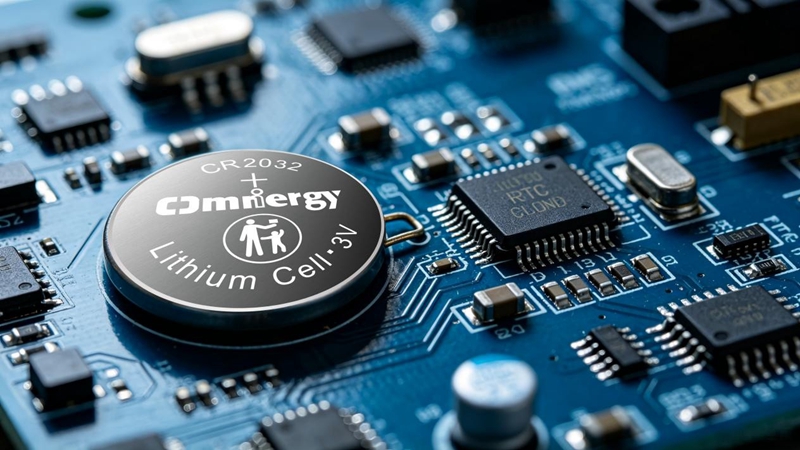
This is an application unique to NEVs. The Battery Management System (BMS) main control board requires a coin-cell battery to power the RTC module. When the vehicle enters deep sleep mode, the main MCU is powered down; the RTC chip operates in a backup mode with power consumption as low as approximately 0.3µA, responsible for periodically waking up the BMS to perform cell voltage and temperature checks, as well as static State of Charge (SOC) correction. Common battery models include CR2032 or BR2330. Internal combustion engine vehicles lack a traction battery pack; consequently, they do not require a BMS or this specific backup battery.
Smart key cards.
Some NEV models replace traditional remote key fobs with thin NFC or Bluetooth cards. These cards also contain a built-in CR2032 battery, adding another unit to the vehicle's total battery count.
RTCs in other controllers.
Components such as the T-Box communication module and the Vehicle Control Unit (VCU) in certain models also have independent RTC requirements and may be equipped with one or two additional coin-cell batteries, depending on the specific vehicle design.
3. A Misconception to Clarify
The 12V low-voltage system in new energy vehicles powers a wide range of electronic components—such as Sentry Mode cameras, NFC readers, and OTA update modules—all of which are driven by a 12V battery (either lead-acid or lithium iron phosphate) that is charged by the main traction battery pack via a DC-DC converter. The emergency backup power supply for the T-Box typically utilizes a nickel-metal hydride (NiMH) battery pack, not a coin cell.
In the vehicle, coin cells are tasked with "long-term monitoring at ultra-low power consumption" rather than serving as the primary power source for the equipment.
4.Data Comparison
Application Scenario | Typical Battery Model | ICE Vehicle (Fuel Car) | NEV (New Energy Vehicle) | Remarks |
TPMS (Tire Pressure Monitoring) | CR2450HT / CR2032HT | 4 units (Standard) | 4 units (Standard) | Direct TPMS factory installation penetration rate exceeds 98% |
Remote Key Fob | CR2032 | 1–2 units | 1–2 units | Universal across all brands |
BMS RTC Backup | CR2032 / BR2330 | 0 | 1 unit | Unique to NEVs |
NFC/Bluetooth Card Key | CR2032 | 0 | 0–1 unit | Equipped on some car models |
Other Controller RTC | CR2032 / CR1220 | 0 | 0–2 units | Varies by car model |
Total | 5–6 units | 6–10 units | NEVs have 1–4 more units |
The shift from a range of 5–6 battery cells to 6–10—with each additional cell directly linked to the battery management system or smart entry features—highlights the core characteristics that distinguish new energy vehicles from internal combustion engine vehicles.
As the market penetration of new energy vehicles continues to rise, this incremental increase is being amplified by the expanding base volume.
5. Small Batteries, High Standards
Although the application of coin-cell batteries in automobiles involves "micro-power" consumption, it entails "high entry barriers."
Take TPMS (Tire Pressure Monitoring System) as an example: the sensors are encapsulated within the tires and operate across a temperature range of -40°C to 125°C, with a typical design lifespan of 5 to 10 years. These conditions impose rigorous requirements regarding high-temperature storage life, stable discharge performance across a wide temperature range, and long-term reliability. Meanwhile, BMS RTC backup batteries require an extremely low self-discharge rate, as the RTC must maintain precise timekeeping even when the vehicle remains parked for weeks or months.
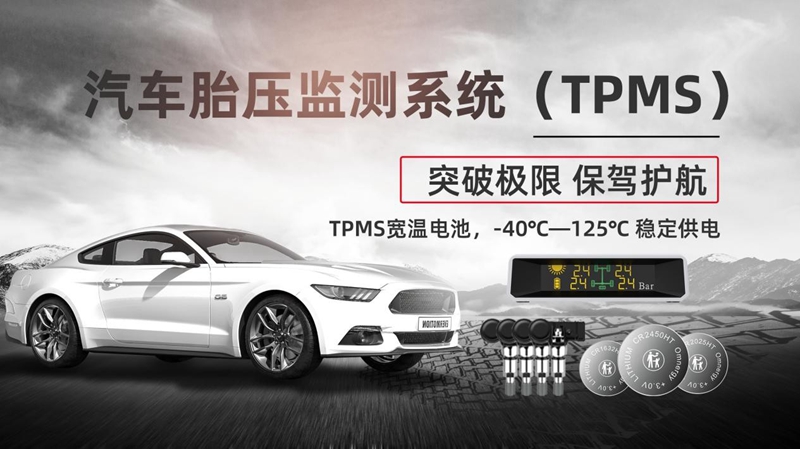
Power Glory’s CR-HT wide-temperature series of coin cells is a product line specifically designed for such demanding operating conditions. Covering key models like the CR2032HT and CR2450HT, the series operates across a temperature range of -40°C to +125°C and holds international certifications such as UN38.3, UL, and CE.
As new energy vehicles continue to gain market share, the integration of each additional coin cell serves as a test of wide-temperature performance and long-term reliability—precisely the value Power Glory delivers through its 22 years of deep expertise in the lithium micro-power sector.