Selection Guide for Disposable Medical Patch Batteries (B2B)
Selection Guide for Disposable Medical Patch Batteries (B2B)
Unexpected interruptions in monitoring data are often not caused by sensor failure, but rather by issues with the built-in micro-battery. Whether it is an ECG patch losing its data connection, a continuous glucose monitor (CGM) transmitter going offline prematurely, or a sweat-monitoring patch suffering from power depletion during storage, the root cause—in cases where both hardware and algorithms are functioning correctly—frequently lies in that easily overlooked coin-cell battery.
For the vast majorty of their operational life, medical patches remain in a microampere-level sleep or standby mode, experiencing a millisecond-long pulse load only when awakened via Bluetooth to transmit data. The reliability of such a device depends not just on sensing precision, but also on the battery’s ability to maintain a stable voltage during the critical moment of radio-frequency (RF) transmission, ensuring that vital sign data is uploaded in its entirety.
With over two decades of deep expertise in lithium micro-power sources, Power Glory offers CR-series lithium-manganese coin-cell batteries. These batteries are characterized by excellent pulse-discharge performance, a stable discharge plateau, an annual self-discharge rate of less than 2%, and consistent output across a wide temperature range—making them the ideal choice for single-use medical patches that must remain in a long-term, low-power standby state while ensuring reliable performance at the critical moment of operation.
Note: This article focuses on disposable wearable medical patches powered by coin-cell batteries, such as ECG patches, temperature-monitoring patches, CGM transmitters, and sweat-sensing patches; reusable flexible devices that incorporate charging management are outside the scope of this discussion.
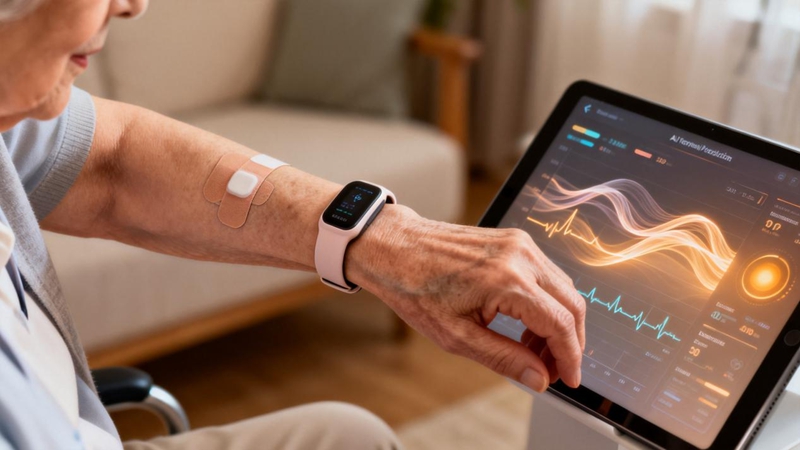
For medical patches, the competition isn't just about sensing—it’s about the voltage at the precise moment data is transmitted.
During the R&D and component selection process, while significant attention is often paid to sensor accuracy, Bluetooth module performance, and wearable comfort, the critical power source—the coin-cell battery—is frequently overlooked. Each time a device performs a Bluetooth broadcast, transmits physiological data, or wakes up via a signal, the RF (radio frequency) chip triggers a transient current surge lasting several milliseconds. When faced with such sudden loads, standard coin-cell batteries may experience a sharp voltage drop; this can lead to issues ranging from data drift, Bluetooth packet loss, and reporting delays, to the device entering a low-voltage sleep mode. In many cases, when a device appears "offline" in the backend system, it is not due to signal interference, but rather a voltage collapse in the battery at the precise moment it attempts to "wake up" and transmit data.
High-pulse capability is not the same as the ability to provide a sustained, high-current output. Its primary value lies in its capacity to withstand the millisecond-scale transient loads generated by RF modules, ensuring a stable output voltage and preventing data acquisition failures caused by momentary voltage drops.

Understand the key performance characteristics to choose the right coin-cell battery for medical patches.
Stable High-Pulse Output: Designed to accommodate millisecond-level transient loads—such as those triggered by Bluetooth wake-ups or data transmissions—this ensures a stable output voltage under typical test conditions, thereby reducing the risk of data loss or transmission delays.
Ample Nominal Capacity: Delivers high capacity within a compact form factor, meeting the varying operational lifespan requirements of devices such as wearable ECG patches, temperature-monitoring patches, and continuous glucose monitors (CGMs). Actual battery life should be verified based on the specific device’s load profile, data transmission frequency, and operating environment.
Ultra-Low Self-Discharge: With an annual self-discharge rate of less than 2%, the battery minimizes the risk of unexpected capacity loss during storage, making it well-suited for mass production, warehousing, and distribution.
Enhanced Leak-Proof Structure: Engineered to withstand prolonged exposure to sweat and moisture, the reinforced leak-proof design lowers the risk of electrolyte leakage, which could otherwise corrode circuit boards or damage sensitive sensing components.
Wide-Temperature Operating Range: Suitable for devices worn on the body, the battery maintains stable performance across diverse environments—including home, office, outdoor, and athletic settings—within a temperature range of -20°C to +70°C.
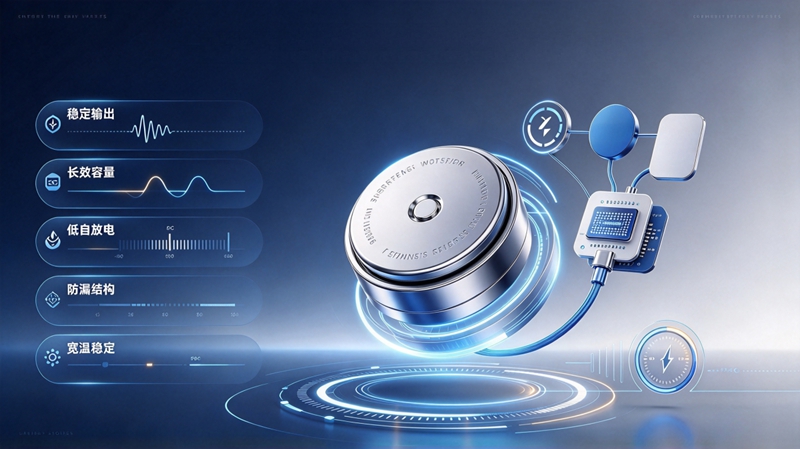
A comprehensive matrix of specifications, covering diverse design requirements for medical patches
Model and dimensions. Even if both provide a 3V output, they are not necessarily interchangeable; a mismatch in diameter or thickness can lead to poor contact with the spring terminals, prevent the casing from closing properly, or even cause physical pressure that damages the PCB.
Model | Diameter × Thickness | Typical Application Scenarios | Selection Tips |
CR2032 | 20 × 3.2 mm | Mainstream ECG and body temperature patches; CGM transmitter evaluation | Preferred for ECG and body temperature; whole-device testing required for CGM transmitters |
CR2025 | 20 × 2.5 mm | Ultra-thin and lightweight vital sign patches | Optional for thin-profile designs |
CR2450 | 24.5 × 5.0 mm | Long-cycle CGM transmitters, multi-parameter acquisition patches | Preferred for high-RF and long-cycle CGM transmitters |
CR1632 | 16 × 3.2 mm | Small-to-medium micro medical patches, compact sensing devices | For structurally constrained devices; evaluate with actual power consumption testing |
CR1225 | 12.5 × 2.5 mm | Ultra-compact medical patches, power supply for narrow compartments | For strict space-constrained designs; relatively low capacity margin |
CR920 | 9.5 × 2.0 mm | Ultra-small CGM patches, micro sensing patches | Suitable for low-power, low-frequency patches; not recommended as the main power source for transmitters |
CR927 | 9.5 × 2.7 mm | Small CGM patches, micro vital sign monitoring patches | Slightly better capacity than CR920 |
CR1025 | 10 × 2.5 mm | Compact CGM patches, micro body temperature patches | Suitable for low-RF-load patches; not recommended to directly replace the main transmitter battery |
The entire product series features stable pulsed discharge, low self-discharge, enhanced leak resistance, and a wide operating temperature range. The CR920, CR927, and CR1025 models have limited pulse capacity and are suitable only for space-constrained sensor patches with low power consumption and infrequent data transmission. For CGM (Continuous Glucose Monitoring) transmitters that require high-frequency BLE (Bluetooth Low Energy) RF transmission, the CR2450 or CR2032 are the preferred choices. Battery selection should be based on the device's mechanical structure, power consumption profile, and empirical test results; replacing a battery based solely on its dimensions is not recommended.
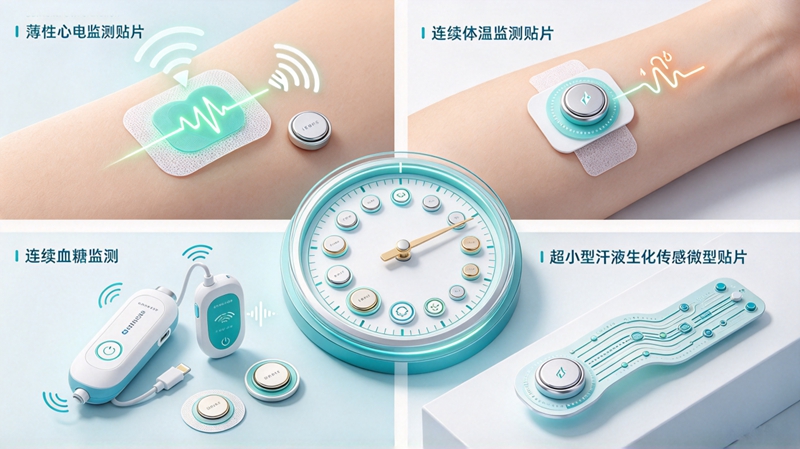
Four Typical Application Scenarios and Selection Recommendations
ECG Monitoring Patch: These devices perform long-term, continuous ECG signal acquisition, with intermittent transmission of waveforms via Bluetooth. Insufficient pulse-discharge performance of the battery can lead to interrupted waveform transmission or the device going offline.
Selection Advice: The CR2032 is the preferred choice for standard designs; for ultra-thin designs, the CR2025 may be considered, subject to verification through testing of the complete device.
Continuous Temperature Monitoring Patch: Significant fluctuations in ambient temperature can cause a drop in apparent battery capacity, potentially triggering false low-battery alerts and interrupting continuous temperature recording. Power Glory’s CR series offers stable performance across a wide temperature range, helping to reduce the risk of data transmission interruptions caused by power supply fluctuations.
Selection Advice: The CR2032 is the mainstream choice; for miniature patches, the CR1632 or CR1025 may be evaluated, with the final selection confirmed based on available physical space and actual battery life testing.
Continuous Glucose Monitoring (CGM) Systems (The transmitter and the sensor patch should be evaluated separately.)
When selecting batteries for a CGM system, one should not simply apply a generic "CGM battery" category. Instead, it is essential to first define the battery's specific role: does it serve as the primary power source for driving BLE (Bluetooth Low Energy) radio-frequency (RF) data transmission, or as an auxiliary power source dedicated solely to sensor data acquisition and standby modes? These two roles impose vastly different requirements in terms of pulse current and capacity.
For the transmitter (which handles BLE RF transmission over a 7–14 day period), RF transmission constitutes the primary dynamic load; in this case, CR2450 or CR2032 batteries should be prioritized. For the sensor patch—characterized by lower RF load, extremely limited internal space, and infrequent data transmission—options such as CR920, CR927, or CR1025 may be considered.
For miniature biochemical sweat-sensing patches, where internal space is highly constrained, the battery must be compact while ensuring a stable power supply. Selection should not be based on dimensions alone; it must be determined by evaluating actual power consumption and RF load requirements.
Selection Recommendations: For small-scale devices, consider CR1632 or CR1225 batteries. In cases where space is even more restricted, consider CR920, CR927, or CR1025. The final choice should be based on a comprehensive assessment of power consumption, RF load, and available physical space.
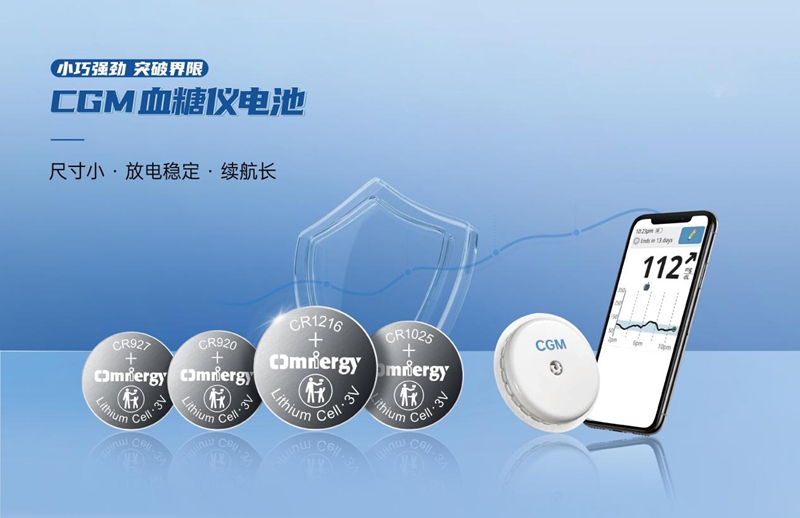
Quick Guide to Avoiding Pitfalls in B2B Battery Selection
Look beyond physical dimensions: Consumer-grade coin cells—even those with identical form factors—are not necessarily suitable for medical patches; they differ significantly in terms of pulse discharge capabilities, self-discharge rates, and leak-proof construction.
Distinguish between power roles: Primary power sources for RF transmitters have different pulse and capacity requirements compared to auxiliary power sources for sensors—a distinction particularly critical for Continuous Glucose Monitoring (CGM) devices.
Validate datasheet specifications through system-level testing: Conduct simulations of actual operating conditions, including pulse discharge, full-cycle aging, and high-temperature storage.
Prioritize self-discharge during storage: Given the long supply chain cycles for medical patches, it is essential to evaluate a battery’s capacity retention after extended periods of storage.
For skin-worn devices, prioritize leak resistance: This helps mitigate the risks of corrosion and safety hazards caused by potential leakage in environments exposed to perspiration.
Small Cells, Safeguarding Well-being
Reliable power for medical patches hinges on several key factors: precise specification matching; the ability to withstand transient RF loads via pulse discharge; sufficient capacity to cover the entire duration of use; low self-discharge to accommodate storage and distribution; leak-proof construction to endure exposure to perspiration; and rigorous quality control to ensure batch-to-batch consistency.
Power Glory’s CR series of lithium-manganese dioxide (Li-MnO₂) coin cells offers a comprehensive range of specifications to meet the size requirements of most medical patches. Providing precise, compact power, they help safeguard every signal—every step of the way.